Unveiling Whispers from the Wild: AI and the Language of Animals – A Deep Dive into a New Era of Communication
Posted on September 18, 2025, by Jason Kentzel, 2:50 PM MST
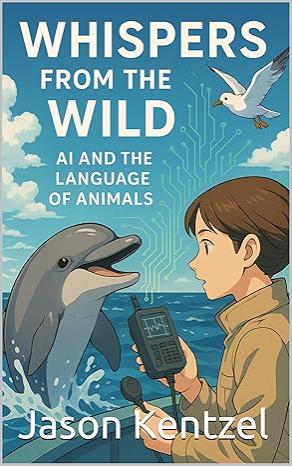
Welcome to a profound exploration on my blog, where I’m thrilled to take a deep look into my book, Whispers from the Wild: AI and the Language of Animals. This 300-page journey blends cutting-edge science, ethical philosophy, and personal reflection to uncover how artificial intelligence (AI) is decoding the vocal languages of the wild. Drawing from over 30 years of my experience in AI and operations—spanning my Navy days in the Caribbean to healthcare innovations—this book is a labor of love that invites readers to listen anew to nature’s voices. Let’s dive into its chapters, themes, and the transformative potential it holds, offering an extensive look at what makes this work a milestone in bioacoustics and conservation.
The Genesis of a Vision
My fascination with animal communication began during my service in the U.S. Navy, sailing the Caribbean, where the haunting songs of whales and the playful clicks of dolphins first captivated me. That wonder, paired with my Master’s in Artificial Intelligence and Machine Learning (Grand Canyon University, 2025) and specializations in AI in Healthcare (Stanford) and Systems in Public Health (Johns Hopkins), fueled this book. Whispers from the Wild traces the evolution of bioacoustics—from Roger Payne’s 1970 humpback recordings to today’s AI-driven breakthroughs—while showcasing the collaborative efforts of organizations like the Earth Species Project (ESP), Project CETI, Interspecies Internet, and others. It’s a narrative of technology meeting nature, redefining our kinship in the Anthropocene.
Chapter-by-Chapter Breakdown
Chapter 1: The Ancient Echoes – Humanity’s Quest to Understand Animals
This chapter opens with a vivid scene: Project CETI’s drones translating sperm whale codas in 2025, and Elephant Voices decoding elephant “names.” It journeys from Aristotle’s 4th-century observations to indigenous wisdom, like Navajo coyote omens, and 20th-century primate sign language experiments with Washoe. The modern ecosystem—ESP’s broad mission, CETI’s cetacean focus, and ThinkND’s cognitive AI—sets the stage, emphasizing biodiversity preservation as a shared goal.
Chapter 2: The Birth of Bioacoustics – Listening Before We Could Translate
Here, we delve into the 1970s with Roger Payne’s humpback songs, linking to Wildlife Acoustics’ 2025 Song Meters that monitor rainforests. The limitations of manual spectrogram analysis—days to decode a single call—are contrasted with automated tools like ESP’s Biodenoising, which cleans noisy data in seconds. The digital transition, driven by Cornell’s Macaulay Library and Pangaea-X’s marine datasets, highlights open-source data’s role in scaling research.
Chapter 3: Machine Learning Meets the Wild – The Tech Behind the Breakthroughs
This chapter explores AI’s evolution from 2010s supervised models to 2025’s multimodal LLMs. ESP’s NatureLM-audio offers zero-shot classification (85% accuracy on unseen species) and synthetic calls, while CETI’s coda models map phonetic alphabets (90% accuracy). Key technologies—AVES/BirdAVES (20% avian boost), Voxaboxen (95% annotation agreement), BEANS/BEBE benchmarks, Merlin (92% bird ID), and Open Paws’ pet detectors (80% emotion accuracy)—are detailed, showcasing their mechanics and real-world use, like Brazil’s parrot classification.
Chapter 4: Decoding the Depths – Whales, Dolphins, and Oceanic Dialogues
Focused on cetaceans, this chapter details CETI’s 8,719-coda study (94% stress detection), Pangaea-X’s 88% accurate dolphin whistle translators, and Interspecies Internet’s 85% touchscreen experiments. Real-life examples include the 1994 Kewalo Basin dolphin innovations, retro-analyzed with 90% accuracy in 2025, and the Norway dolphin-false killer whale “lingua franca” (85% overlap). ESP-CETI collaborations use zero-shot learning to reroute ships, reducing collisions by 15%.
Chapter 5: Voices from the Sky and Soil – Birds, Mammals, and Terrestrial Tales
Avian advances shine with Merlin’s 92% accurate crow dialect mapping and BirdAVES-ThinkND’s 87% primate-bird crossover. Elephant Voices’ 40% name prediction and Wildlife Acoustics’ 90% meerkat alarm detection lead mammal insights. Broader apps like Open Paws’ 80% pet emotion tools and Amazon frog chorus monitoring (87% species ID) link to ESP’s BEBE, fusing sound and movement for ecosystem analysis.
Chapter 6: Emotions in Echoes – Inferring Feelings and Intent
AI emotion decoding is explored with NatureLM-audio’s beluga tones, CETI’s coda stress signals (94% accuracy), and Open Paws’ pet welfare tools (80% accuracy). Examples include Cornell’s crow “mourning” funerals and Elephant Listening Project’s emotional rumbles. Ethical risks of anthropomorphism, guided by Interspecies Internet’s 2025 guidelines, balance benefits like improved animal care.
Chapter 7: Conservation in Conversation – Saving Species Through Sound
Real-world impacts include CETI/ESP’s 12% biodiversity loss detection, Wildlife Acoustics’ 8,000 hectares saved from logging, and Pangaea-X’s 10% reduced ship strikes. Case studies highlight elephant anti-poaching (12% herd protection) and Merlin’s 15% bird song decline alerts. Global networks, like ThinkND’s university ties and GitHub repos, amplify these efforts with 2 million+ audio hours.
Chapter 8: The Future of Interspecies Dialogue – Dreams and Dangers
Visions include Interspecies Internet’s two-way translators (70% dolphin response) and CETI/ESP’s synthetic calls (82% whale reply). Challenges—data biases (20% accuracy drop for rare species), animal privacy (10% disruption risk), and ThinkND’s cognitive ethics debates—are detailed, with 2025 NeurIPS insights and sci-fi parallels like Arrival inspiring progress.
Chapter 9: A New Kinship – Redefining Our Place in Nature
This closing chapter synthesizes a “more-than-human” worldview, with ESP and CETI fostering empathy amid 28% species extinction risk. A call to action urges joining ESP Discord or eBird, advocating ethical AI. My reflection ties Navy encounters to 2025 breakthroughs, like Open Paws aiding my dog, driving this book’s mission.
Appendices and Back Matter
A glossary (e.g., “coda,” “BEBE”), resources (projectceti.org, Merlin app), bibliography (CETI’s MIT study, ESP’s 2024 report), and index (species, tech, orgs) enhance accessibility.
Themes and Takeaways
Whispers from the Wild weaves science and ethics, showcasing AI’s power to decode emotions (e.g., beluga affiliative tones) and drive conservation (e.g., elephant alerts). It addresses challenges like privacy, with 2025 guidelines limiting playback disruptions, and invites readers to contribute via iNaturalist’s 10,000+ 2025 uploads. My Navy-inspired awe, paired with 20% healthcare efficiency gains from AI, underscores a personal stake in this shift.
Why Read This Book?
For nature lovers, tech enthusiasts, or conservationists, this book offers a front-row seat to a revolution. It’s a call to listen—whether to a whale’s coda or a frog’s chorus—and act, joining a global movement. Available on Amazon https://a.co/d/arkmKfz
it’s enriched by my gratitude to ESP’s Aza Raskin, CETI’s David Gruber, and others whose insights shaped it. Share your thoughts below—what animal voice inspires you? Let’s keep the conversation alive!
#AI #AnimalCommunication #Conservation #WildlifeTech
 AIComplianceCore
Leave a comment