In a market flooded with AI books promising to “revolutionize” everything from your morning coffee to global economies, it’s easy to get caught up in the hype. Titles touting “The AI Revolution” or “Unlocking Superintelligence” dominate bestseller lists, often focusing on futuristic visions, buzzwords like “AGI,” and speculative scenarios. But what if the real power of AI lies not in grand promises, but in grounded, measurable processes that ensure it’s built right the first time?
That’s where Six Sigma for AI Innovation stands apart. This isn’t another hype-driven manifesto—it’s a practical guide rooted in the proven methodology of Six Sigma, adapted for the complexities of AI development and governance. Drawing on over 30 years of operations leadership and a Master’s in AI/ML, the book shows how to integrate Six Sigma’s data-driven rigor with AI to create systems that are not only innovative but also reliable, ethical, and compliant. No fluff, just actionable strategies for real-world challenges.
One of the book’s core strengths is its focus on blending process excellence with AI’s potential. Six Sigma—famous for reducing defects to near-zero levels—provides tools like DMAIC (Define, Measure, Analyze, Improve, Control) to tame AI’s inherent variability. Whether you’re optimizing models in healthcare or ensuring fairness in finance, the book demonstrates how this combination turns AI from a risky experiment into a precision tool.
Let’s break down one key topic from the book: “Bias and Fairness: Using Six Sigma to Measure and Reduce Disparities” (Chapter 9, Part 2). This section tackles a pervasive issue in AI—bias—that’s often glossed over in hype-focused books but is critical for ethical deployment.
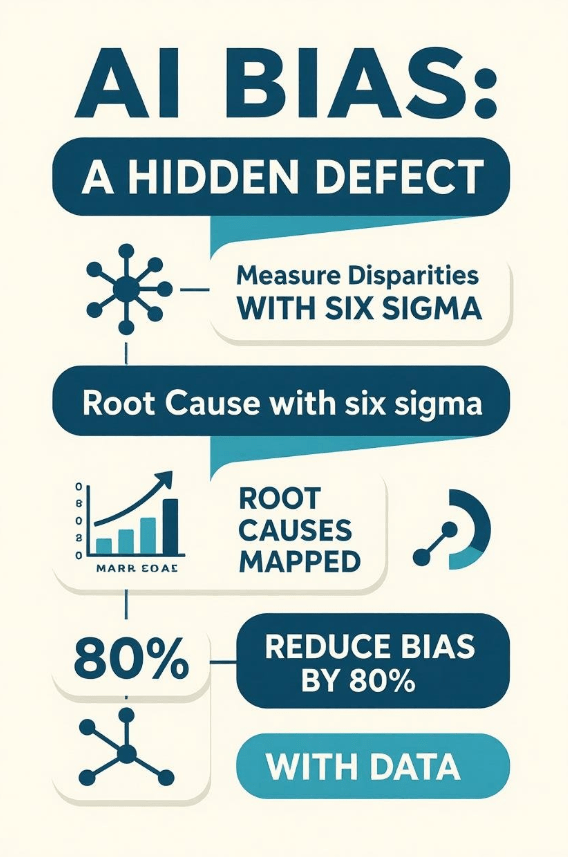
Understanding Bias in AI: The Hidden Defect
AI bias isn’t a bug; it’s a systemic defect that creeps in during the model’s lifecycle. In the book, bias is defined as skewed outcomes that unfairly disadvantage certain groups, often due to imbalanced training data or flawed algorithms. For example, a facial recognition system trained mostly on light-skinned faces might fail darker-skinned individuals, leading to discriminatory results in hiring or security applications.
Six Sigma treats bias as a process variation to be measured and controlled. The chapter emphasizes starting with the Measure phase: Quantify disparities using fairness metrics like demographic parity (equal selection rates across groups) or equal opportunity (equal true positive rates). Imagine an AI hiring tool with a 15% disparity in approval rates between genders—that’s your baseline defect rate.
Analyzing Root Causes: Digging Deeper
Once measured, the Analyze phase uncovers why bias occurs. The book uses Six Sigma tools like cause-and-effect diagrams (fishbone) to map sources: biased datasets (e.g., underrepresentation of minorities), algorithmic flaws (e.g., overemphasis on biased features), process issues (e.g., inconsistent preprocessing), or human factors (e.g., subjective annotations).
Pareto charts help prioritize: Often, 70% of disparities stem from data imbalances. Hypothesis testing validates these causes—e.g., confirming if underrepresentation significantly increases disparity (p < 0.05). Real-world examples abound: Amazon’s hiring AI penalized women’s resumes due to gendered language in training data, or COMPAS software predicted higher recidivism for Black defendants because of historical biases in criminal justice data.
Improving Fairness: Targeted Solutions
The Improve phase is where Six Sigma shines. The book outlines strategies like data augmentation—adding synthetic data for underrepresented groups—to balance datasets. For instance, in a healthcare AI predicting disease risk, augmenting data for elderly patients reduces age-based disparities from 15% to 3%.
Fairness-aware algorithms, such as adversarial training, enforce metrics like equal opportunity during model training. Design of Experiments (DOE) tests these solutions: Vary augmentation levels or algorithm constraints to find the optimal setup that minimizes bias without sacrificing accuracy.
Controlling for Sustainability
Finally, the Control phase sustains fairness with tools like Statistical Process Control (SPC). Monitor fairness metrics with control charts—set limits at ±3σ from the target (e.g., <5% disparity)—and trigger alerts for deviations. The book stresses governance protocols, like regular audits, to embed these controls into AI pipelines.
This methodical approach turns bias from a vague ethical concern into a quantifiable, fixable process defect. In healthcare, it ensures equitable patient outcomes; in finance, fair credit decisions. Unlike hype-driven AI narratives, Six Sigma grounds innovation in precision, making AI trustworthy and compliant.
If you’re ready to move beyond the buzz and build AI that delivers real value, Six Sigma for AI Innovation is your guide. Available on Amazon! https://a.co/d/c9Ld70I
What bias challenges have you faced in AI? Let’s discuss below! #AIInnovation #SixSigma #EthicalAI #DataDriven
 AIComplianceCore
Leave a comment