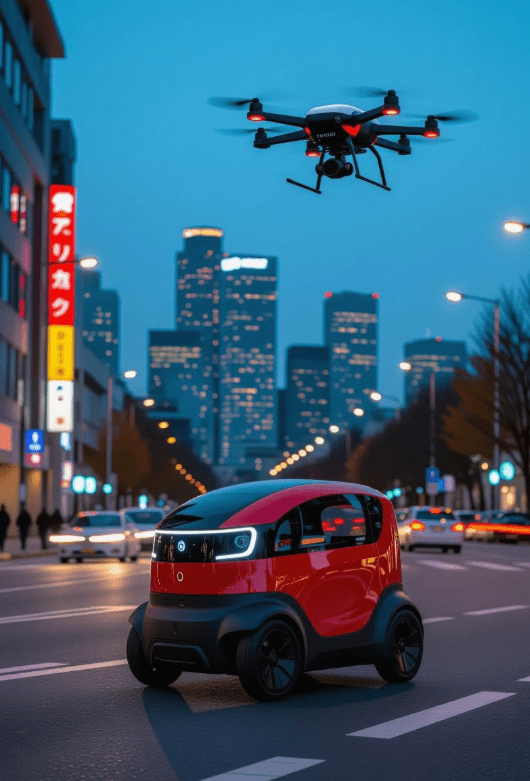
In the fast-paced world of e-commerce and on-demand services, the last mile of delivery has long been the bottleneck—costly, inefficient, and prone to human error. Enter 2025: the year autonomous delivery truly takes off. From DoorDash’s newly launched “Dot” robot zipping through Phoenix bike lanes at 20 mph to Wing’s drone fleets dropping packages in Dallas backyards, these machines are reshaping urban logistics. But with innovation comes cultural pushback: terms like “clanker”—a nod to Star Wars battle droids—are surging in online slang, turning robots into meme-worthy villains.
This in-depth guide dives into the emerging tech, comparing key players, regional deployments, pros and cons, and even the cheeky lingo. We’ll break it down with lists, tables, and visualizations to help you navigate this robotic revolution.
Ground-Based Robots: Paving the Sidewalk to Your Doorstep
Autonomous ground robots—compact, wheeled or tracked vehicles navigating sidewalks, bike lanes, and streets—dominate urban and suburban deliveries. They’re ideal for short-haul food and grocery runs, carrying payloads from 5-50 lbs. As of October 2025, the market is booming, projected to hit $3.2 billion by 2030 at a 32% CAGR.
Key Companies and Models
Here’s a comprehensive list of top US-deployed ground robots, focusing on commercial ops:
| Company | Model | Payload Capacity | Top Speed | Range | Key Features | Partnerships |
|---|---|---|---|---|---|---|
| Nuro | R3 | Up to 500 lbs | 45 mph | 12+ miles | Fully enclosed cargo, Level 4 autonomy, collision avoidance | Kroger, Domino’s, Walmart |
| Starship Technologies | Gen 4 | 44 lbs | 4.3 mph (sidewalk) | 4 miles | AI navigation, 99% autonomous, sidewalk-focused | Uber Eats, campuses nationwide |
| DoorDash | Dot | 50 lbs | 20 mph | 5-7 miles | Multi-terrain (bike lanes/roads), compact (1/10 car size) | DoorDash ecosystem, Phoenix pilot |
| Serve Robotics | Gen 2 | 50 lbs | 5 mph | 3 miles | Solar-powered, Uber integration | Uber Eats, LA/Dallas/Atlanta/Chicago |
| Kiwibot | K5 | 20 lbs | 4 mph | 2 miles | Campus-optimized, obstacle detection | Universities (Pittsburgh, Miami, Berkeley) |
| Avride | AV Pod | 100 lbs | 10 mph | 5 miles | Modular for food/packages | Uber Eats, Ohio State (112-unit fleet) |
| Ottonomy.IO | Ottobot | 220 lbs | 4 mph | 3 miles | Indoor/outdoor versatility | Airports, hospitals, retail |
| Refraction AI | Scout | 50 lbs | 10 mph | 4 miles | Bike-lane navigation | Austin/Ann Arbor pilots |
Data sourced from company specs and 2025 industry reports.
Regional Deployments
Deployments cluster in tech hubs, but expansion is accelerating:
- West Coast (California): Epicenter with Nuro and Starship in SF/Bay Area; DoorDash’s Dot in Phoenix; 40% of US ops here due to favorable regs.
- Southwest (Texas): Nuro/Serve in Dallas/Houston; urban testing for heat/resilience.
- Midwest/Northeast: Avride at Ohio State; Kiwibot in Pittsburgh/Berkeley extensions.
- Southeast: Serve in Atlanta; emerging in Florida via Ottonomy.
By Q3 2025, over 5,000 robots are active, with California/Texas accounting for 60%.
Pros and Cons
Pros:
- Cost Savings: Up to 70% lower per-delivery costs vs. human drivers; scales without wage hikes.
- Efficiency: 99.5% on-time accuracy; handles peak hours without fatigue.
- Sustainability: Electric, low-emission; reduces urban traffic by 20-30%.
- Safety: Fewer accidents in controlled zones; AI avoids pedestrians.
Cons:
- Limited Capacity/Speed: Sidewalk caps (e.g., 5 mph) slow dense routes; weather vulnerabilities.
- Infrastructure Needs: Requires clear paths; urban clutter causes 15% failure rates.
- Job Displacement: Threatens gig economy roles; unions protesting in LA.
- High Upfront Costs: $10K-50K per unit; ROI takes 1-2 years.
Aerial Drones: Sky-High Speed for the Win
Drones offer vertical bypass of traffic, excelling in rural/suburban drops for packages up to 5-50 lbs. FAA’s 2025 BVLOS rules have supercharged growth, with 1 million+ flights logged.
Key Companies and Models
Top players and their specs:
| Company | Model | Payload Capacity | Top Speed | Range | Key Features | Partnerships |
|---|---|---|---|---|---|---|
| Wing (Alphabet) | MK3 | 2.5 lbs | 65 mph | 12 miles | VTOL, winch delivery | Walmart, DoorDash (500K+ flights) |
| Zipline | P2 | 8 lbs | 70 mph | 50 miles | Fixed-wing, parachute drops | Walmart (NC/AR, 1.4M global flights) |
| Flytrex | TRX2 | 3 lbs | 46 mph | 5 miles | Backyard hovers | Walmart/Uber (37 metros by EOY) |
| DroneUp | BlackFly | 5 lbs | 60 mph | 10 miles | VTOL autonomy | Walmart (VA/AR/UT/FL, 100K deliveries) |
| Matternet | M2 | 4.4 lbs | 62 mph | 12 miles | Medical focus, FAA Part 135 | Hospitals (CA) |
| UPS Flight Forward | Ranger | 50 lbs | 50 mph | 20 miles | Cargo hubs | UPS (OH/NC/TX) |
| Amazon Prime Air | MK30 | 5 lbs | 70 mph | 15 miles | Prime integration | Pilots in TX/CA (100+ deliveries) |
| Volansi (Wingcopter) | 198 | 13 lbs | 93 mph | 62 miles | Long-range VTOL | B2B (CA military/retail) |
Compiled from 2025 specs.
Regional Deployments
Drones thrive where airspace is less congested:
- Southeast (North Carolina/Virginia): Flytrex/DroneUp hubs; 30% of flights for Walmart.
- Southwest (Texas): Wing/Amazon in Dallas/College Station; heat-tested ops.
- West Coast (California): Matternet/Volansi in urban air corridors.
- Midwest/South: Zipline expanding to 10+ states; UPS in Ohio.
Texas and NC lead with 50% share, fueled by FAA waivers.
Pros and Cons
Pros:
- Speed: 30-min deliveries; bypasses traffic for 3x faster rural access.
- Scalability: Low per-mile costs; handles surges via fleets.
- Eco-Friendly: Zero emissions; reduces van miles by 90%.
- Precision: GPS/AI for pinpoint drops, even in remote areas.
Cons:
- Payload/Range Limits: Small loads; weather (wind/rain) grounds 20% of flights.
- Regulatory Hurdles: BVLOS approvals vary; privacy concerns in suburbs.
- Safety Risks: Bird strikes or malfunctions; FAA reports 5% incident rate.
- Noise/Intrusion: Buzzing annoys residents; “drone fatigue” in pilots.
Head-to-Head: Robots vs. Drones – A Visual Breakdown
To compare, let’s visualize key metrics. (In WordPress, embed a chart via plugin like WP DataTables or Google Charts. Here’s sample data for a bar graph:)
Graph 1: Average Speed Comparison (mph)
- Ground Robots: 10-20 mph (urban avg.)
- Drones: 50-70 mph (aerial avg.)
Bar Chart Placeholder: Robots (blue bars: Nuro 45, Dot 20); Drones (green: Zipline 70, Wing 65). Source: Model specs.
Graph 2: Deployment Scale by Region (Units Active, Q3 2025)
- CA/TX (Robots): 3,000 units
- NC/VA (Drones): 2,500 flights/day
Pie Chart Placeholder: West 40%, Southwest 25%, Southeast 20%, Other 15%.
Overall Comparison Table:
| Metric | Ground Robots | Drones |
|---|---|---|
| Best For | Urban food/groceries | Suburban packages/medical |
| Cost per Delivery | $1-2 | $0.50-1.50 |
| Error Rate | 5-10% (obstacles) | 3-7% (weather) |
| Market Share 2025 | 60% | 40% |
Ground robots edge out in density, but drones win on speed/range.
The Cultural Backlash: “Clankers” and Robot Memes
As bots invade daily life, slang like “clanker” has exploded—up 300% on X since January 2025. Rooted in Star Wars (clone troopers mocking droids), it’s now a jab at real machines: “These clankers better not spill my tacos” (re: Dot). Viral July post by @Keegan59992745 (“All of you [robots] are getting cancelled”) sparked 116K likes, fueling debates on “robo-phobia.”
Other gems: “Spawncamped clanker” for vandalized bots or “flying clanker burrito taxi.” It’s edgy humor masking fears of job loss and surveillance—yet it humanizes the tech, making it relatable.
Conclusion: Fast-Forward to a Bot-Delivered Tomorrow
Autonomous delivery isn’t sci-fi anymore; it’s here, slashing costs and emissions while challenging norms. Robots rule cities, drones conquer skies, but success hinges on regs, ethics, and maybe ditching the “clanker” shade. By 2030, expect hybrid fleets dominating 50% of last-mile ops. What’s your take—game-changer or glitchy gimmick? Drop a comment below!
Sources: Aggregated from industry reports and real-time X data.
 AIComplianceCore
Leave a comment