
In an era where healthcare systems worldwide grapple with escalating costs, clinician burnout, and the demands of an aging population, artificial intelligence (AI) emerges not as a futuristic promise, but as a tangible force driving transformation. As of 2025, AI adoption in healthcare has surged, with spending nearly tripling year-over-year to $1.4 billion in the U.S. alone. This blog post delves deep into how AI is reshaping the healthcare landscape—exploring its profound benefits, the hurdles to widespread implementation, real-world case studies that showcase its impact, and the broader ways it’s revolutionizing diagnostics, treatment, and operations. Backed by the latest data and trends, we’ll also visualize key metrics through insightful charts to illustrate the trajectory of this technological revolution.
Whether you’re a healthcare executive, clinician, or patient advocate, understanding AI’s role is crucial. Let’s explore why 2025 marks a pivotal year for AI in healthcare.
The Explosive Growth of AI in Healthcare: A Market on Fire
The AI in healthcare market isn’t just growing—it’s exploding. Valued at approximately $26.57 billion in 2024, projections indicate it will skyrocket to $187.69 billion by 2030, fueled by a compound annual growth rate (CAGR) of 38.62%. This growth is propelled by the need for efficiency amid rising chronic diseases and data deluge, with 46% of U.S. healthcare organizations now in early stages of generative AI implementation.
To visualize this momentum, consider the market’s trajectory. The following line chart plots the projected market size from 2024 to 2030, highlighting the steep upward curve that underscores AI’s potential to address systemic inefficiencies.
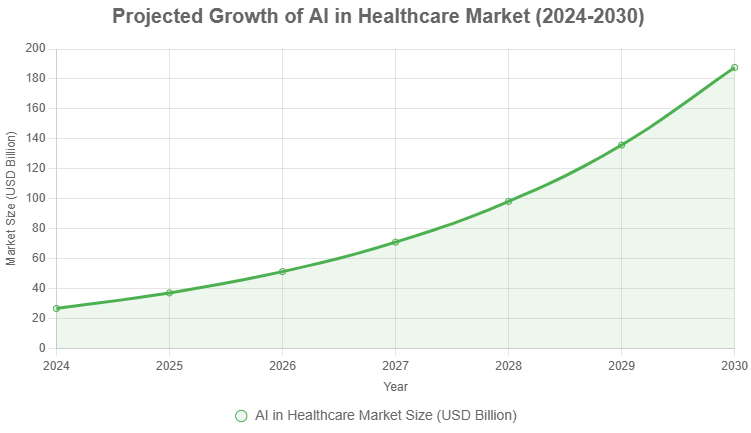
This chart reveals not just numbers, but a narrative: AI is scaling from niche applications to foundational infrastructure, with North America leading at 56% market share due to high investments and tech-savvy providers.
How AI is Transforming Healthcare: From Reactive to Predictive Care
AI isn’t merely automating tasks—it’s fundamentally altering how healthcare is delivered, shifting paradigms from reactive treatment to proactive prevention. In diagnostics, AI algorithms now outperform humans in pattern recognition; for instance, deep learning models detect COVID-19 cases with 68% accuracy where initial human diagnoses faltered. Beyond that, AI powers predictive analytics to forecast disease outbreaks, personalize treatment plans, and optimize resource allocation.
Consider drug discovery: Traditional timelines spanning 10-15 years are being slashed by AI’s ability to simulate molecular interactions, accelerating breakthroughs in areas like oncology and rare diseases. In operations, ambient clinical documentation tools—adopted by 100% of surveyed health systems—use generative AI to transcribe and summarize notes, freeing clinicians from hours of paperwork.
Telemedicine has evolved with AI-infused virtual assistants, providing real-time triage and reducing emergency room visits by up to 30% in pilot programs. Moreover, AI-driven genomics is enabling precision medicine, where treatments are tailored to individual genetic profiles, potentially improving outcomes by 20-30% in cancer care.
This transformation extends to global health equity. In resource-limited settings like Ghana, AI models classify medicinal plants for traditional remedies, blending ancient knowledge with modern tech to expand access to care. As NVIDIA’s 2025 survey notes, AI’s integration into imaging and IoT devices is enhancing clinician-patient interactions while cutting operational costs by 15-20%.
The Tangible Benefits: Efficiency, Accuracy, and Empowerment
The allure of AI lies in its multifaceted benefits, which directly tackle healthcare’s pain points. First and foremost is improved diagnostic accuracy. AI tools in radiology, such as those from GE Healthcare, boost detection rates for cancers by 14.5% over human reports alone, minimizing discrepancies and enabling earlier interventions. A bar chart below illustrates this edge, comparing AI-assisted vs. traditional methods across key metrics.
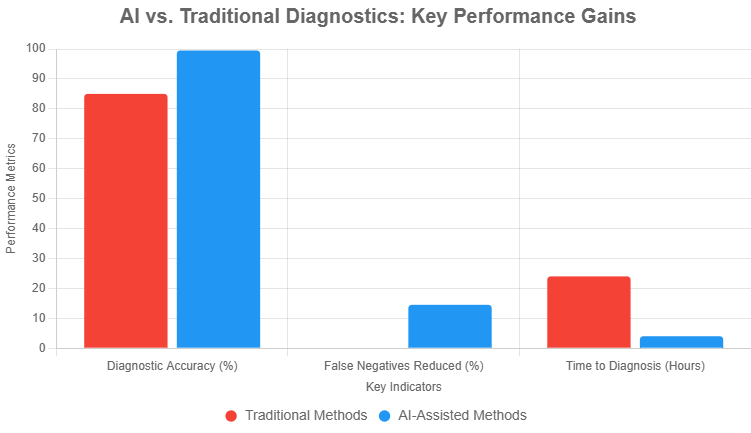
Second, operational efficiency is a game-changer. With clinician burnout rampant—exacerbated by a projected shortage of 200,000 nurses and 100,000 physicians by decade’s end—AI reduces administrative burdens by 57%, allowing more time for patient interaction. Tools like predictive staffing models cut wait times by 40% in emergency departments.
Third, cost savings are profound. AI streamlines supply chains and prevents readmissions, potentially saving the U.S. system $25-30 billion annually by 2025 through optimized resource use. Patient empowerment rounds out the benefits: AI chatbots and wearables provide personalized health insights, boosting adherence to treatment plans by 25%.
Finally, 68% of physicians now recognize AI’s value in patient care, up from 63% in 2023, signaling a cultural shift toward acceptance.
Navigating the Challenges: Barriers to Full-Scale Adoption
Despite the promise, AI adoption faces formidable obstacles. Data privacy and bias top the list: Inaccurate training data can perpetuate discrimination, with 83% of consumers citing error risks as a deterrent. Regulatory uncertainty—evident in evolving FDA guidelines and state laws like Maryland’s HB 1240—slows deployment, as does interoperability with legacy systems.
Financial constraints hit smaller organizations hardest, with budget limitations cited as the primary barrier for 70% of those under 1,000 employees. Ethical concerns, including liability for AI errors, further erode trust, particularly among clinicians wary of “black box” algorithms.
A pie chart here breaks down these challenges based on 2025 surveys, emphasizing the need for robust governance.
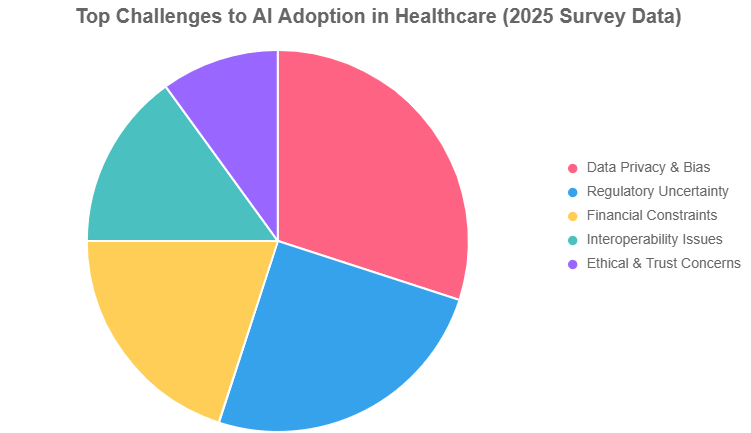
Mitigation strategies include AI guardrails for bias detection and partnerships for ethical frameworks, as outlined in recent JAMIA studies. Addressing these will unlock AI’s full potential.
Case Studies: Real-World Wins with AI
Nothing illustrates AI’s impact like success stories.
Case Study 1: GE Healthcare’s AI in Breast Cancer Screening In 2025, GE’s AI-enhanced mammography tools reduced false positives by 14.5% in a study of 158 cases, improving recall accuracy and patient anxiety. This led to a 20% drop in unnecessary biopsies, saving costs and resources while enabling earlier detections.
Case Study 2: NVIDIA’s Predictive Analytics in Yorkshire, UK An AI model analyzed mobility, pulse, and oxygen levels to predict hospital transfers with 80% accuracy, reducing readmissions by 30% and alleviating provider workloads. Deployed across NHS trusts, it exemplifies AI’s role in equitable care.
Case Study 3: IBM Watson Health in Drug Discovery IBM’s platform accelerated oncology drug trials by 40%, identifying candidates overlooked by traditional methods. In a 2025 collaboration with pharma giants, it cut development timelines from years to months, advancing treatments for rare blood disorders.
These cases, drawn from diverse settings, highlight AI’s versatility—from urban hospitals to rural clinics.
The Road Ahead: Ethical AI and Sustainable Integration
Looking to 2030, AI will deepen its integration, with trends like embodied AI (e.g., robotic assistants) and continuous learning loops promising hyper-personalized care. Yet, success hinges on ethical deployment: Transparent algorithms, diverse datasets, and clinician involvement are non-negotiable.
Healthcare leaders must invest in upskilling—66% of physicians now use AI tools, but training gaps persist. Policymakers should harmonize regulations to foster innovation without compromising safety.
Conclusion: Embracing AI for a Healthier Tomorrow
AI adoption in healthcare is no longer optional—it’s imperative. By enhancing accuracy, slashing costs, and empowering providers, AI addresses the quadruple aim of better outcomes, experiences, and efficiencies at lower costs. While challenges like bias and regulation loom, the case studies and growth projections paint an optimistic picture.
As we stand in 2025, the question isn’t if AI will transform healthcare, but how swiftly we adapt. For organizations ready to lead, the rewards—healthier patients, streamlined operations, and innovative breakthroughs—are immense. What’s your take? Share in the comments below, and stay tuned for more on emerging tech.
Sources: Insights drawn from NVIDIA, Forbes, Grand View Research, and JAMIA reports (2025). All data current as of October 2025.
 AIComplianceCore
Leave a comment