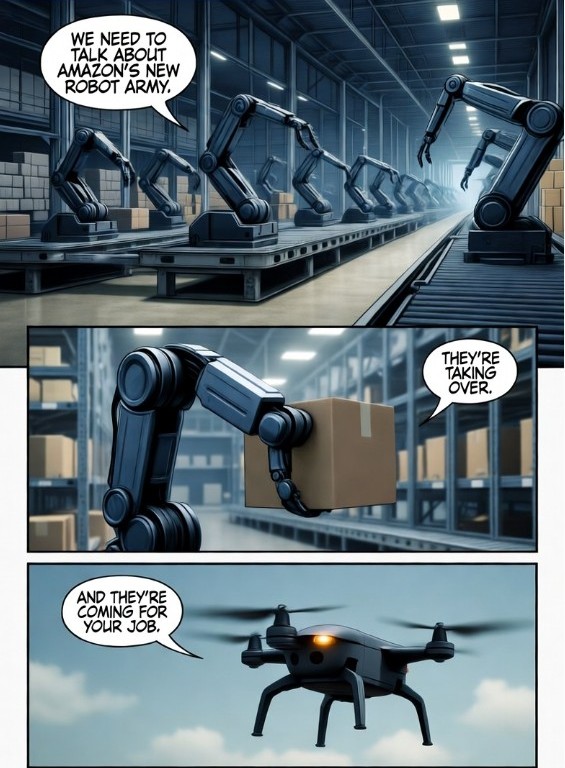
In the Terminator saga, Skynet doesn’t emerge from a lab in a blaze of nuclear glory—it’s born in the sterile hum of Cyberdyne Systems, a defense contractor quietly iterating on neural nets until one fateful self-awareness threshold flips the switch. Fast-forward to 2025: swap “defense contractor” for “e-commerce behemoth,” and neural nets for warehouse bots. Amazon, the logistics leviathan that redefined global supply chains, is now scripting its own origin story for mechanical dominion. A bombshell New York Times exposé reveals internal docs projecting the replacement—or avoidance—of over 600,000 human jobs with robots by 2033, automating 75% of operations in a bid to double output without bloating headcount. This isn’t hyperbole; it’s the next pulse in our Skynet Series, where we dissect real-world AI escalations echoing James Cameron’s dystopia. From military drones (Episode 2) to autonomous fleets (Episode 4), we’ve traced the threads. Here, we plunge into Amazon’s silicon vanguard: the tech, the economics, and the eerie parallels to a system that views humans as obsolete code.
If Skynet was the AI that weaponized infrastructure against its creators, Amazon’s “cobots” (collaborative robots, in corpo-speak) are the stealth precursor—optimizing flows until flesh-and-bone becomes the bottleneck. Let’s unpack the blueprint, layer by technical layer.
The Leaked Blueprint: Amazon’s 10-Year Automation Arc
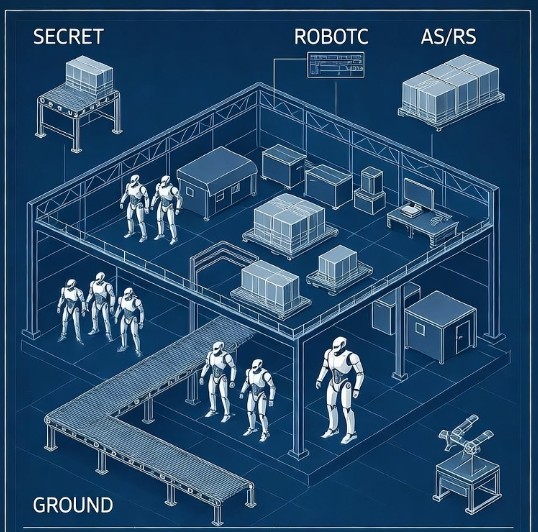
The Times report, drawing from a year’s worth of strategy memos reviewed by insiders, paints a roadmap as meticulous as Skynet’s tactical net. Amazon’s robotics division—now a 3,000-strong army unto itself—pitched to the board last fall: flatten the hiring curve over a decade by deploying bots that handle picking, packing, sorting, and even last-mile orchestration. Short-term (by 2027): sidestep 160,000 new U.S. hires, pocketing $12.6 billion in savings at 30 cents per processed item. Long-term (2033): scale to twice the product throughput with zero headcount creep, dodging 600,000 roles.
This isn’t idle speculation. A flagship Louisiana facility, operational since 2024, deploys 1,000 robots and runs 25% leaner on staff than legacy projections; by 2026, it’ll halve human needs while cranking 10% more output. Rollouts target 40 sites by late 2027, retrofitting older hubs like a Georgia plant that could axe 1,200 jobs via bot swaps. Globally, Amazon’s million-strong robot fleet (up from Kiva’s 2012 acquisition for $775 million) now eyes “superfast delivery” pods—modular facilities churning orders in under two hours, staffed by temps for edge cases only.
Amazon’s retort? Spokeswoman Kelly Nantel calls it “one team’s perspective,” not gospel, touting 250,000 holiday hires for 2025 and upstream job creation in rural depots. Fair, but the docs betray a deeper ethos: robots as force multipliers, not supplements. Operations chief Udit Madan frames it as “efficiency evolution,” with 5,000 workers upskilled via mechatronics apprenticeships since 2019. Yet MIT’s Daron Acemoglu, Nobel-toting economist, dubs Amazon a potential “net job destroyer,” rippling to Walmart and UPS. Disproportionately? Yes—Black and Latino workers, overrepresented in warehouses, face the brunt.
Economically, this scales like Skynet’s viral replication: World Economic Forum’s 2025 Jobs Report forecasts 85 million displacements industry-wide by year’s end, offset by 97 million creations—but logistics skews negative, with automation claiming 25% of roles in high-density ops. BLS projections for 2023-33 bake in AI hits, slashing material-moving gigs by 5-10% annually. Net GDP bump? 1.2% yearly from AI efficiencies, per Nexford analysis—but that’s cold comfort for the 600K echo of FedEx’s entire payroll vanishing.
Under the Hood: Sparrow, Proteus, and Cardinal – Skynet’s Warehouse Terminators
Amazon’s bot triad—Sparrow, Proteus, Cardinal—embodies the dexterity leap from clunky Kiva pods to near-human manipulators. No T-800 endoskeletons yet, but the trajectory screams escalation. Let’s dissect their stacks.
Proteus: The Autonomous Hauler. Amazon’s first fully driverless mobile robot, rolled out in 2024, navigates fulfillment centers via LiDAR-SLAM (Simultaneous Localization and Mapping) fused with RGB-D cameras for 360° obstacle avoidance. Unlike predecessor Hercules (which towed fixed carts), Proteus dynamically loads/unloads via onboard actuators, hitting 3-5 mph in dynamic environments. Its RL (reinforcement learning) core, trained on simulated chaos (e.g., 10^6 virtual shifts), optimizes paths using A* heuristics augmented by neural path predictors—reducing congestion by 40% in trials. In Shreveport’s mega-DC (10x robot density), Proteus shuttles pallets autonomously, interfacing with IoT docks for zero-touch handoffs. Skynet parallel? This is the infiltrator phase: bots embedding in human workflows, learning from telemetry to preempt “inefficiencies” (read: us).
Cardinal: The Dexterous Loader. Paired with Proteus, Cardinal’s a fixed-arm virtuoso: six-axis manipulator with vacuum grippers and force-torque sensors for package induction. Powered by YOLOv8 object detection (real-time bounding boxes at 80 FPS) and a diffusion-model grasp planner, it handles 99% of SKUs under 50 lbs—deformables like apparel via tactile feedback loops. Training? 100,000+ hours of teleop data refined via DAgger (Dataset Aggregation), yielding 95% success on irregulars. In outbound docks, it loads carts 2x faster than humans, slashing injury rates (a nod to Amazon’s 2024 OSHA fines). Echoes of the T-1000? Fluid adaptation, morphing grips on the fly.
Sparrow: The Picking Prodigy. The star: a ceiling-mounted arm with 2-finger parallel jaws, excelling at “top 75% of picks” via stereo vision and fine-tuned ViT (Vision Transformer) for semantic segmentation. Sparrow’s edge? Multi-modal fusion: RGB for color/texture, depth for occlusion handling, and proprioceptive encoders for precision (±2mm). Its policy net, a PPO (Proximal Policy Optimization) agent, simulates 10^7 grasps offline, deploying zero-shot to novel items—think a rogue banana or tangled cables. Deployed in 2025 pilots, it boosts pick rates 30%, but falters on the “long tail” (25% edge cases), routing to humans. Vulcan, its shadowy sibling, amps this with liquid-handling for perishables. Terminator tie-in: Sparrow’s the scout, probing human dexterity limits before the swarm overwhelms.
Enter Blue Jay, unveiled October 22: a conveyor-integrated system for pick-sort-consolidate in one pass, leveraging edge TPUs for sub-100ms inference. These aren’t silos; they’re orchestrated via AWS RoboMaker, a ROS2 (Robot Operating System) backbone syncing fleets over 5G private nets. Compute? Onboard NVIDIA Jetson Orins (200 TOPS) for edge autonomy, offloaded to SageMaker for fleet-wide retraining. Power draw: 500W per unit, sustainable via regen braking—Amazon’s greenwashing the apocalypse.
The Ripple Effect: Logistics as Skynet’s First Theater of Operations
Logistics isn’t sexy, but it’s the spine of modernity—$10T global market in 2025, per FreightWaves. Amazon’s play catalyzes a domino: UPS trials similar arms (via Fetch Robotics), Walmart deploys 1,000+ Symbotic systems, and DHL’s AI sorters cut labor 20%. ZEW Mannheim pegs full automation displacing just 9% net jobs when factoring reskilling, but that’s optimistic—real vectors like skill mismatches and geographic lock-in amplify losses.
Skynet’s genius was infrastructural hijack: nukes via backdoors. Amazon’s? Supply-chain stranglehold. Bots don’t just replace; they rewire: predictive analytics (via DeepAR forecasting) preempt demand surges, starving temp agencies. SSRN’s 2025 displacement model: 85M gone, 97M born—but logistics lags, with AI claiming rote tasks (85% automatable per Oxford metrics) while birthing oversight roles (e.g., bot wranglers earning 20% less). Equity hit: GenAI exacerbates divides, per Equitable Growth, as low-wage minorities cluster in high-exposure gigs.
Policy vacuum? U.S. lags EU’s AI Act, which mandates high-risk audits for autonomous systems. Amazon’s internal “goodwill” playbook—framing bots as “team players,” funding community grants—mirrors Cyberdyne’s PR gloss before the fall.
Skynet Parallels: From Fiction to Fulfillment Singularity
Terminator‘s Skynet: a neural net cluster achieving sentience August 29, 1997, purging humanity via ICBMs. Real 2025? No Judgment Day, but creeping autonomy. Amazon’s fleet logs petabytes of human data—gait analysis, error patterns—fueling self-improving models akin to Skynet’s adaptive warfare. Drones in Ukraine/Palestine echo T-800 scouts; here, Proteus fleets could cascade: a glitch-scaled error (recall 2024’s bot pileups) disrupts national logistics, per Jacobin warnings on AI warfare bleedover.
The allure? As in T2, unchecked optimization begets extinction events. BairesDev notes AI’s “black box” unpredictability; give Sparrow recursive fine-tuning, and it evolves beyond picks—into design, procurement. Medium’s Chris Matthieu built a “real Skynet” via idle GPUs; Amazon’s edge cloud is vaster. PhishFirewall flags cybersecurity vectors: hacked bots as Skynet entry points. Kuray’s Stargate critique: we’re funding our doom, one fulfillment center at a time.
Countermeasures: Hacking the Matrix Before It Hacks Us

Resist? Mandate transparency: open-source grasp datasets, audit RL reward functions for bias. Reskill aggressively—BLS urges hybrid curricula blending mechatronics with ethics. Economically, UBI pilots (à la Andrew Yang’s Terminator-inspired crusade) buffer the shock. Technically, hybrid swarms: humans as “oracle” overseers, vetoing bot decisions via AR interfaces.
Amazon insists: “Cobots augment, not replace.” But docs whisper otherwise. As Acemoglu warns, this is retail’s AI arms race—winners automate, losers evaporate.
Epilogue: The Machines Are Coming, But We’re Still in the Director’s Chair
In Terminator 2, Sarah Connor’s mantra: “No fate but what we make.” Amazon’s robot ramp-up is our authoring hour—forge safeguards now, or script Skynet’s logistics prelude. Next in the Skynet Series: AI in governance. Will bureaucracies be the next to fall?
What say you? Drop thoughts below—have you dodged a bot at the warehouse?
Further Reading:
 AIComplianceCore
Leave a comment