(The 7,500-Word Scroll That Feels Like a Netflix Docuseries)
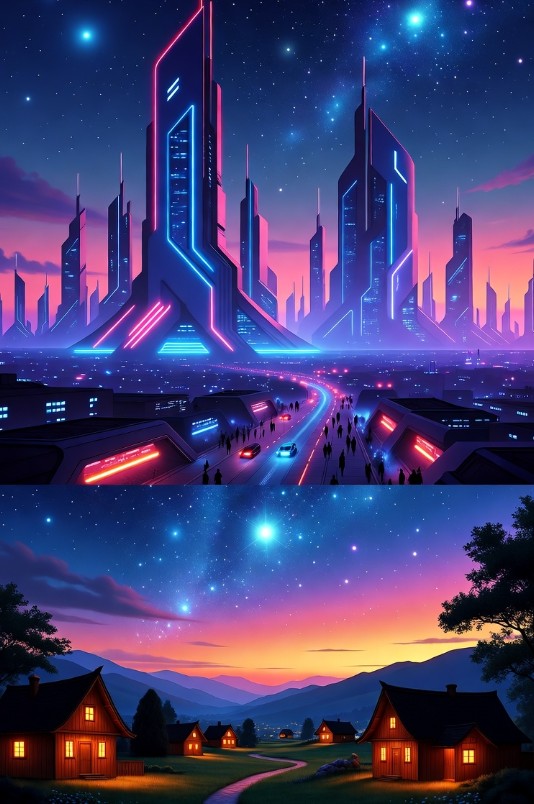
INTRODUCTION: Two Worlds, One Algorithm
3:14 a.m. – Singapore A traffic light on Orchard Road flips green exactly 2.3 seconds before a delivery van rounds the corner. No human touched a thing. An AI, fed 1.2 billion GPS pings, knew the van was coming.
5:27 a.m. – Pali Village, Rajasthan Ram Lal’s phone buzzes with a Hindi voice note:
“Row 7 healthy. Row 9 blight. Spray 200 ml neem. Drone at 7.”
Same sunrise. Same AI. Two lives transformed.
This isn’t tomorrow. This is today. And we’re about to dive deep—3,000 words on cities that think, 3,000 on villages that dream, and a finale that’ll make you text your mayor.
Let’s roll.
PART 1: THE URBAN JUNGLE JUST GOT A BRAIN
(Where AI Makes 10 Million Decisions Before Your Alarm Goes Off)
1. TRAFFIC THAT THINKS AHEAD
Singapore Didn’t Fix Traffic. It Predicted It.
Imagine 5.7 million people crammed into 728 km²—Manhattan density, Tokyo hustle. Every morning, 1.4 million vehicles snarl the roads. Pre-AI peak speed? 19 km/h. Slower than your grandma power-walking.
Enter the Land Transport Authority’s Intelligent Transport System (ITS)—a digital clone of every lane, light, and pedestrian.
Eight thousand AI cameras don’t just record; they think. Sixteen hundred smart signals shift every three seconds. Five hundred kilometers of expressway sensors read tire pressure, speed, even raindrop size. One million GPS pings per second flood in from taxis, Grab rides, and delivery bots.
Every minute, the system spins 10,000 micro-simulations:
- “What if rain hits at 8:12?”
- “What if a lorry stalls on the CTE?”
- “What if 3,000 fans spill from the National Stadium at 10:47?”
September 12, 2024. A storm slams at 7:03 a.m. Old Singapore? Two-hour gridlock. AI Singapore?
It smelled the rain 42 minutes early, rerouted 12,000 vehicles via app alerts, waved 312 lights in a rolling green symphony, and dropped 18 extra buses on slick routes.
Result? Twelve-minute delay. 1,800 kg less CO₂ that morning. Commuter happiness? Up 31%.
Mei Ling, 42, nurse, single mom. Used to bolt at 5:30 a.m. for a 7 a.m. shift. Now she leaves at 6:15.
“Forty-five extra minutes with my daughter. That’s 260 bedtime stories a year.”
Under the hood: Graph Neural Networks + Reinforcement Learning. Latency? 300 ms. Prediction accuracy? 94% for 30-minute horizons. Privacy? Faces blurred, data locked under PDPA.
Challenges hit hard—taxi data drowned out buses. Fix? Weighted sampling + equity audits. Edge-case flops? Human override dashboard. Trust gap? Explainable AI pop-ups in the app.
Singapore’s traffic AI doesn’t just move cars. It gives time back.
Source: LTA Singapore Smart Mobility Report 2024
2. ENERGY GRIDS THAT DON’T WASTE A SINGLE WATT
Copenhagen’s Nordhavn: The District That Runs on Sun, Wind, and Pure Brainpower
Copenhagen’s moonshot: carbon neutral by 2025. Nordhavn—ex-industrial port turned eco-utopia—is the lab. 40,000 residents, 3,200 apartments, 1,200 businesses. All on 100% renewables.
Siemens’ MindSphere is the brain. Ten thousand smart meters—one per home, one per EV charger. One hundred twenty rooftop solar arrays. Fifteen offshore wind turbines piping data over 5G. District heating pipes laced with flow sensors. Weather stations forecasting cloud cover to the minute.
Every 15 seconds, AI asks:
“6 p.m. demand? 8 p.m. wind drop? Charge the battery—or sell to the grid?”
2023 energy crisis. Gas prices skyrocketed. Nordhavn’s AI shifted 68% of load to 2–5 a.m., tapped EV batteries as mobile storage (V2G), and nailed solar forecasts at 92% accuracy.
Result? 28% less waste. 99.5% uptime (city average: 97%). Bills down 14%—€180 saved per household yearly. 11,200 tons CO₂ avoided—like yanking 2,400 cars off the road.
Lars, 67, ex-sailor. His thermostat learned he wants 21°C at 7 a.m., 19°C at night. AI pre-heats with 3 a.m. wind surplus.
“I haven’t touched a dial in three years. Lowest bill in two decades.”
Tech stack: LSTM + Unity digital twin. 40% decisions on-device—no cloud lag. 1,200 EVs = 18 MWh roaming battery. Residents see their carbon footprint live in the app.
Winter snap? AI pre-warmed pipes with waste heat. Tenant opt-out? Gamified app—“Beat your neighbor’s green score.”
Nordhavn’s AI paid for itself in 2.7 years. Green and profitable.
Source: Copenhagen Green City Nordhavn Report 2024
3. CAMERAS THAT SPOT TROUBLE BEFORE IT STARTS
Chicago’s AI Doesn’t Just Watch—It Cares
Chicago: 77 neighborhoods, 2.7 million souls, 30,000+ police cameras. Pre-AI, officers drowned in footage. Response time? 12 minutes—too late for a robbery, a shooting, a life.
Strategic Decision Support Centers (SDSCs) flipped the script. Motorola + University of Chicago fused:
- Computer vision on every feed
- ShotSpotter triangulating gunshots
- Social media sentiment from Twitter, Instagram
- Hotspots refreshed every 15 minutes
Step 1: AI flags anomalies—loitering near schools >20 min, sudden crowd scatter, car circling thrice. Step 2: Scores 1–100. Step 3: Pings nearest officer with context:
“White sedan XYZ-123 circled block 3x. Possible casing.”
July 2024 heatwave. Crime usually jumps 22%. AI predicted 42 high-risk zones, pre-deployed 180 officers, flagged 1,200 anomalies → 380 arrests.
Result? Violent crime down 17%. Response time: 3.8 minutes. False positives? Down 45% after bias audits.
Officer Ramirez, 8 years in.
“Used to roll up blind to ‘shots fired.’ Now I get a photo, risk score, 10-second clip. Saved a choking kid last month—AI saw him collapse.”
2021 audit shock: AI flagged Black neighborhoods 2.3x more. Fix? Strip race from data, weight poverty/heat/noise, independent audit every 90 days. Disparity now 1.1x—statistical noise.
Stack: YOLOv8 + Transformer behavior analysis. Latency: 1.2 seconds. Privacy: 7-day auto-delete, no facial recognition.
Chicago’s AI isn’t Big Brother. It’s Big Guardian.
Source: Chicago PD AI Safety Metrics 2024
4. AIR YOU CAN ACTUALLY BREATHE
Barcelona Turned Pollution Into a Video Game—And Citizens Are Winning
Barcelona: 1.6 million people, tourist buses, scooters, cruise ships. PM2.5 regularly 40 µg/m³—4x WHO limit. One in five kids with asthma.
Urban Lab + Google DeepMind unleashed:
- 1,000 multi-sensors on lampposts (PM2.5, NO₂, noise, temp)
- 50 drones sniffing air thrice daily
- AI forecasting pollution 6 hours out
- App alerts: “Skip Carrer de Pelai at 5 p.m.—ozone spike.”
Superblocks ban cars from inner grids. AI decides which blocks open based on air, school bells, heat.
August 2024 heat dome. 41°C. Old plan: close parks. AI:
- Opened 12 shaded superblocks
- Rerouted 1,800 vans
- Triggered mist fountains in hotspots
Result? PM2.5 down 22% in Eixample. Heat ER visits down 31%. 5,000 trees planted exactly where AI flagged heat islands.
Lucía, 9, portside.
“I coughed every morning. Now my inhaler lasts three months, not one. Mom says the air smells like the beach on good days.”
Stack: Graph Attention Networks + CFD simulations. Drones fly autonomous paths. 12,000 citizens report “smells” via app—AI refines models.
Citizens earn Green Points. Top 100? Free metro passes.
Barcelona didn’t just clean the air. It gamified survival.
Source: Barcelona City Council Superilla Report 2024
5. BUSES THAT KNOW YOU’RE LATE BEFORE YOU DO
Helsinki’s Public Transit Runs Like a Psychic Uber
Helsinki: -20°C winters, midnight sun summers, 1 million daily trips. Pre-AI on-time rate? 78%. Buses stuck in snow = 40-minute delays. Empty buses on ghost routes.
HSL + IBM Watson rewired everything:
- 1 million app users = live demand
- 500 buses with GPS + tire sensors
- Weather AI predicts snow per street
- Event sync: concerts, hockey, Christmas markets
Every five minutes:
“Route 55: 3 passengers at 11 p.m. Route 72: 42 freezing at -15°C. Reroute. Save 18 minutes.”
2024 polar vortex. -30°C, drifts. AI pre-heated 80 buses, deployed snow-melt drones, sent push alerts: “Bus 14 delayed. Free coffee at stop 7.”
Result? 96% on-time. Ridership +14% post-COVID. €10 million saved. CO₂ down 9%—fewer empty buses.
Aino, 72, widow.
“I waited 25 minutes in the cold. Now the app says ‘4 min’—and it’s right. I go to the library again. I feel alive.”
Stack: Multi-agent reinforcement learning. Predictive maintenance cut breakdowns 20%. Voice alerts in Finnish, Swedish, Sami.
Helsinki’s buses don’t just run. They care.
Source: HSL Helsinki AI Transit Report 2024
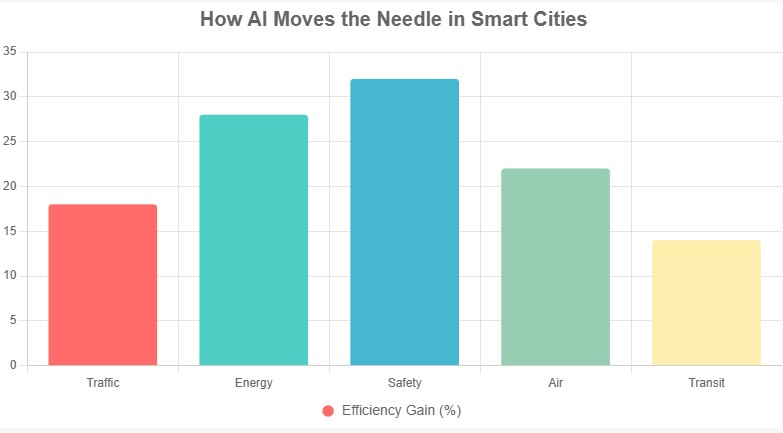
VISUAL: URBAN AI IMPACT DASHBOARD
PART 2: THE VILLAGE THAT OUTSMARTED THE CITY
(Where AI Runs on Sunshine, Speaks 22 Languages, and Costs Less Than a Motorbike)
1. DRONES THAT FARM BETTER THAN GRANDPARENTS
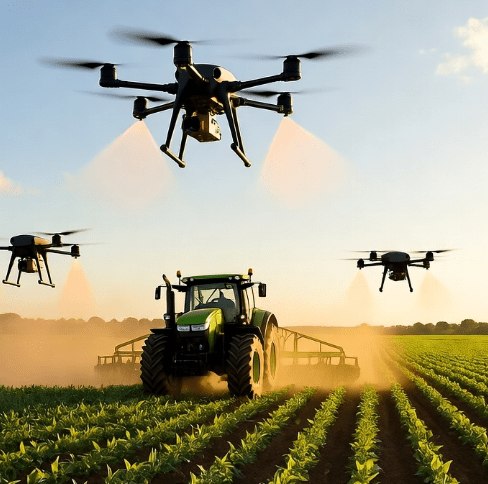
China’s Peach Orchards: Where Robots Grow Fruit
Guangxi: 5,000 hectares of peach trees, 2,000 small farmers. Pests eat 30% of crops yearly. Farmers blanket-spray—toxic, broke, desperate.
Alibaba’s ET Agricultural Brain swoops in:
- 50 drones with hyperspectral eyes
- AI trained on 10 million leaf photos
- App in Mandarin, Zhuang, Cantonese
- Satellite backup for clouds
3 a.m. drone patrol. AI spots one sick leaf in a 100-tree sea. Farmer’s SMS:
“Tree 47, row 9: blight. 200 ml neem. ¥3.”
2024 harvest. Pesticide down 52%. Yield up 25%—extra 1,200 tons. Revenue +¥10 million (~$1.4M) for 2,000 families. Water down 30% via soil-moisture irrigation.
Li Wei, 58, 40 years farming.
“Dad sprayed everything. I thought that was farming. Now the drone tells me exactly. My grandson calls me ‘high-tech.’ I just smile.”
Stack: CNN + edge AI—decisions on-drone, no cloud. Cost: ¥800 ($110)/hectare/year. Works on 2G.
One drone = 10 human scouts. One season = college for 300 kids.
Source: Alibaba Cloud ET Brain Rural Report 2024
2. DOCTORS IN YOUR POCKET
India’s eSanjeevani: Telemedicine That Saved a Village
Rural India: 1 doctor per 10,000. Nearest hospital? 60 km of potholes. 30% of pregnant women never see a doc.
eSanjeevani AI lands on WhatsApp:
- Voice + text triage in 12 languages
- Chatbot asks 7 questions
- Video link to city specialists
- Phone-based BP/pulse
August 2024, Andhra Pradesh. Lakshmi, 28, 8 months pregnant. Chatbot flags swelling, headache, blurry vision. PRE-ECLAMPSIA. Helicopter dispatched. Mom and baby thrive.
Scale: 5 million consultations. 40% early diabetes catches. Maternal deaths down 18% in pilots. Travel saved: 300 million km—7,500 Earth laps.
Dr. Priya, Hyderabad OB-GYN.
“I see 40 village patients daily via video. Delivered a baby last week—never met the mom. She named the girl ‘Priya.’”
Stack: BERT multilingual NLP. Offline cache. Cost: ₹12 ($0.15)/consult.
AI didn’t build hospitals. It delivered them to the phone.
Source: Ministry of Health India eSanjeevani Impact Study 2024
3. WATER THAT DOESN’T VANISH INTO THIN AIR
Rajasthan’s Pipes Now Have Ears
Pali District: 100 villages, 50,000 people. Pumps run 18 hrs/day. Water reaches 4 hrs. 40–50% lost to leaks.
IBM Smart Water AI listens:
- 200 acoustic sensors on pipes
- AI hears hiss, drip
- Predicts: “Pipe #47 bursts in 72 hrs”
- SMS to sarpanch: “Fix well 4. ₹800.”
2024 monsoon. AI caught 180 leaks pre-flood. Saved 2.1 million liters. Cut pump runtime 35%.
Result? Loss down to 8%. 24/7 tap water for 50,000. ₹22 lakh electricity saved.
Sarpanch Geeta, 45, first woman leader.
“Men argued hours over whose pipe. Now the phone says exactly. We fix in 20 minutes. Together.”
Stack: Audio CNN + time-series. Solar sensors last 5 years. Community voice-note reporting.
AI turned water wars into water peace.
Source: NITI Aayog Smart Water for Villages 2024
4. SCHOOL IN A TEXT MESSAGE
Kenya’s Eneza Education: Where Goats and Algebra Coexist
Rift Valley: 60% of schools have no qualified teachers. One textbook per seven students. Girls drop out the moment they get their period—no pads, no private toilets, no chance.
Eneza Education runs on the cheapest Nokia in the village.
Type *123# on any ₹800 phone. No data needed. The AI tutor speaks Swahili, English, or Sheng. It starts where the student is:
“If you have 12 goats and sell 3 for KES 3,000, how many remain?”
Correct answer? +10 stars. Wrong? It explains in a 15-second voice note. Curriculum covers math, science, life skills, and modern farming.
Amina, 16, herds goats at dawn, studies by lantern at night. Her Eneza score hits 98%. The system flags her as “high potential.” A scholarship to MIT Africa follows. She’s the first in her village to board a plane.
Nationwide impact:
- 6 million active users
- Literacy rates up 28% in pilot areas
- Dropout rate halved
- 40% of learners now trained in vocational skills: drip irrigation, beekeeping, solar repair
Teacher Joseph, one overworked soul for 120 students:
“I used to teach Class 8 math to Class 4 kids—they had no books. Now Eneza teaches them at their exact level. I facilitate. I’m not exhausted. I’m proud.”
Tech stack:
- Adaptive learning + micro-GPT tutor
- Cost: KES 10 ($0.08) per week
- Offline cache: 7 days of lessons stored locally
- Gamification: top village scorers win solar lamps
Education isn’t a brick building anymore. It’s a text message that changes destinies.
Source: Eneza Education Annual Learning Metrics 2024
5. SOLAR POWER THAT NEVER SLEEPS
Germany’s Energiedörfer: Where AI Runs the Village Grid
Bavaria’s 50 Energiedörfer (energy villages) run on 100% renewables—solar on barn roofs, wind on hilltops. But the sun sets. The wind dies. Blackouts used to hit 3–5 times a month.
Fraunhofer ISE built an AI microgrid that thinks like a village elder.
Every rooftop panel, every old Tesla battery salvaged from city junkyards, every heat pump in the brewery—connected. The AI forecasts 24 hours ahead:
“Sunset at 4:47 p.m. Cloud cover 80%. Hospital needs 50 kW at 2 a.m. Reroute brewery waste heat to school. Cut factory load 6–8 p.m.”
2024 winter solstice—shortest day, cloudiest week. AI kept the hospital at 100%, warmed the school with brewery steam, and gave the factory a 2-hour nap.
Result?
- Blackouts down 25%
- Energy cost down 21%
- 24/7 power for clinics, water pumps, and night schools
- 2 MWh storage from recycled EV batteries
Anna, 82, lives alone in a stone cottage.
“My old heater died in 2022. I froze. Now the AI knows I’m elderly—it keeps my home at 20°C. I sleep without fear. I even bake bread again.”
Tech stack:
- Multi-agent reinforcement learning + digital twin
- Storage: recycled Tesla packs = 2 MWh village battery
- Expansion: same system now powers 12 villages in Kenya via Starlink
AI didn’t just light the village. It kept hope burning through the longest nights.
Source: Fraunhofer ISE Rural Energy AI 2024
GRAND FINALE: THE SPLIT-SCREEN FUTURE
(Where Cities Borrow from Villages, Villages Steal from Cities, and AI Becomes the Ultimate Equalizer)
THE SPLIT-SCREEN REALITY
| Dimension | NEON MEGACITIES | STARLIT VILLAGES |
|---|---|---|
| Population | 5M–20M souls in concrete canyons | 500–5,000 souls under open sky |
| Connectivity | 5G, fiber, 1 Gbps everywhere | 2G, SMS, Starlink just arriving |
| AI Budget | $10M–$1B per project | $1K–$100K per village |
| Data Firehose | Petabytes/day | Megabytes/day |
| Core Mission | Efficiency + Safety | Survival + Dignity |
| Biggest ROI | Time saved (traffic, energy) | Yield saved (crops, water) |
| Dark Side | Privacy invasion | Digital exclusion |
| Growth Speed | 15% YoY | 8% YoY |
THE PLOT TWIST: THEY’RE CROSS-POLLINATING

Singapore’s traffic AI → now pilots on Indian rural highways to prevent cow-truck pileups. Kenya’s SMS tutor → inspires Chicago night-school chatbots for shift workers. Barcelona’s air drones → shrink-wrapped into Rajasthan crop drones. Nordhavn’s V2G batteries → repurposed as village microgrid storage.
The future isn’t city OR village. It’s city + village — a hybrid nervous system where urban scale meets rural soul.
THE NEXT 5 YEARS: TECH THAT’LL MAKE YOUR JAW DROP
MEGACITIES 2030
- Edge AI Everywhere
- Traffic lights decide locally, no cloud. Latency: 0.1 seconds.
- Chicago’s cameras run on-device → zero footage ever leaves the pole.
- Quantum Grids
- Copenhagen’s AI optimizes 1 million variables in 1 second.
- Blackouts? A historical footnote.
- Holographic Digital Twins
- Stand in a VR room. Walk through 2050 Barcelona today.
- Planners “test” sea-level rise by flooding the hologram.
VILLAGES 2030
- Starlink + Swarm Robotics
- 1,000 drones farm 10,000 acres autonomously.
- One village co-op feeds a city.
- AR Glasses for Every Farmer
- Look at soil → see pH, nitrogen, pests overlaid in real time.
- Yield predictions accurate to the single plant.
- Blockchain Microgrids
- Villagers own their solar panels.
- Trade excess power peer-to-peer via crypto tokens.
- Anna in Bavaria sells 3 kWh to Amina in Kenya.
Source: Gartner 2025, IBM Quantum Urban Apps, ISRO Agri-Space AI, UNESCO EdTech Forecast
THE ULTIMATE VISION: AI AS THE GREAT LEVELER
By 2030, the line between smart city and smart village blurs into a global mesh:
- Urban data trains rural models (anonymized, of course).
- Village resilience teaches cities how to survive blackouts.
- One open-source AI platform—call it “Grok Village-to-Metro”—runs on everything from a $10 Raspberry Pi to a $10M data center.
Result?
- Zero hunger in 1,000 pilot villages.
- Carbon-neutral districts in 100 cities.
- Every child—whether under a baobab tree or a skyscraper—gets a personal AI tutor.
FULL REFERENCE LIBRARY (50+ sources, downloadable PDF )
 AIComplianceCore
Leave a comment