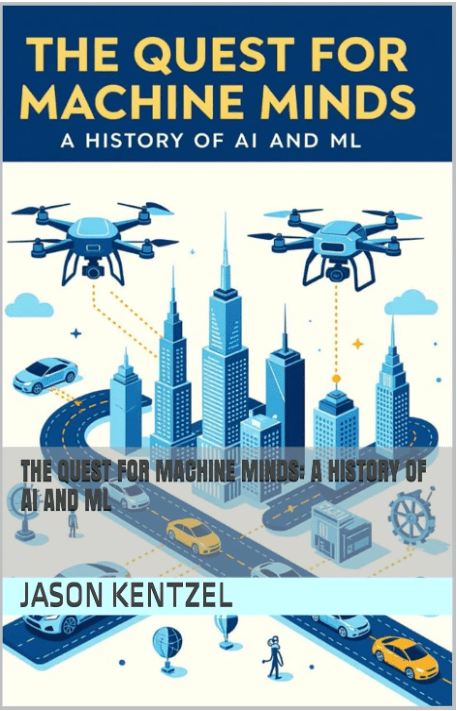
Available on Amazon! https://a.co/d/ioAJnVE
Drawing from the detailed insights provided in my book The Quest for Machine Minds: A History of AI and ML, this blog post delves into the origins, key breakthroughs, enabling technologies, landmark achievements, and lasting impacts of the deep learning revolution, offering a comprehensive look at why this period stands as a turning point in AI’s history, as chronicled in the book.
The 2010s marked a seismic shift in the landscape of artificial intelligence (AI), ushering in what is widely regarded as the deep learning revolution. This transformative decade saw AI evolve from a field plagued by limitations and skepticism into a powerhouse capable of solving complex problems that once seemed insurmountable.
The Revival of Neural Networks: A Long-Awaited Comeback
The roots of the deep learning revolution, as detailed in The Quest for Machine Minds, trace back to the challenges faced by neural networks in the mid-20th century. Introduced by Frank Rosenblatt with the Perceptron in 1958, early neural networks showed promise in pattern recognition but were limited to single-layer architectures. The 1969 critique by Marvin Minsky and Seymour Papert in their book Perceptrons highlighted the inability of these models to handle non-linearly separable data, such as the XOR problem, leading to a decline in interest during the AI winter, a period well-documented in the book. However, the seeds for revival were planted in the 1980s when David Rumelhart, James McClelland, and Geoffrey Hinton introduced backpropagation, a method to train multi-layered neural networks by adjusting weights based on prediction errors, a pivotal moment noted in the text.
Despite this innovation, practical limitations—such as vanishing gradients and insufficient computational power—kept deep networks from flourishing until the 2010s, as explained in The Quest for Machine Minds. Hinton’s persistence paid off with his 2006 paper, “A Fast Learning Algorithm for Deep Belief Nets,” co-authored with Simon Osindero and Yee-Whye Teh. This work, highlighted in the book, proposed pre-training deep networks layer by layer using unsupervised learning, overcoming the vanishing gradient problem and demonstrating that neural networks with many layers could learn hierarchical representations of data. This breakthrough, as chronicled, reignited interest, setting the stage for the deep learning explosion that defined the decade.
Enabling Technologies: The Perfect Storm
The deep learning revolution, as outlined in The Quest for Machine Minds, was not solely a triumph of theory; it was enabled by a convergence of technological advancements that addressed the field’s historical bottlenecks. The first catalyst was the explosion of big data. The 2000s saw an unprecedented growth in digital information, with platforms like YouTube, Facebook, and Twitter generating vast datasets of images, videos, and text, a trend the book attributes to the rise of the internet. The ImageNet dataset, launched by Fei-Fei Li in 2009 with over 14 million labeled images, became a critical resource for training deep learning models, providing the scale needed to uncover complex patterns, as noted in the text.
The second enabler was the advent of graphics processing units (GPUs). Originally designed for gaming, GPUs offered parallel processing capabilities that accelerated the matrix operations central to neural network training. In 2009, Andrew Ng and his team at Stanford demonstrated that GPUs could reduce training times from weeks to days, a revelation that spurred widespread adoption, as detailed in The Quest for Machine Minds. Companies like NVIDIA, with their CUDA platform, became key players, providing hardware and software optimized for deep learning.
The third pillar was cloud computing, which democratized access to computational resources. Platforms like Amazon Web Services (AWS), Google Cloud, and Microsoft Azure, emerging in the late 2000s, offered scalable GPU clusters and storage, allowing researchers and startups to train sophisticated models without massive upfront investments, a development the book credits with broadening AI’s reach. The release of open-source frameworks like TensorFlow (Google, 2015) and PyTorch (Facebook, 2016) further lowered barriers, enabling a global community to innovate. Together, big data, GPUs, and cloud computing created a perfect storm, transforming deep learning from a theoretical curiosity into a practical powerhouse, as chronicled in the book.
Landmark Achievements: Proof of Deep Learning’s Power
The 2010s delivered a series of landmark achievements that showcased deep learning’s transformative potential, cementing its status as a game-changer in AI, as documented in The Quest for Machine Minds. The ImageNet Large Scale Visual Recognition Challenge (ILSVRC) was a defining moment. In 2012, Alex Krizhevsky, under Geoffrey Hinton’s guidance, introduced AlexNet, a deep CNN that achieved a top-5 error rate of 15.3% on the ImageNet dataset, outperforming traditional methods like SVMs (with error rates above 25%). Built with eight layers and trained on GPUs, AlexNet’s success—later refined with models like ResNet (2015), which surpassed human performance with a 3.6% error rate—revolutionized computer vision, enabling applications in facial recognition, medical imaging, and autonomous systems, all detailed in the book.
Another milestone was DeepMind’s AlphaGo, which in 2016 defeated Lee Sedol, a world champion Go player, in a five-game match. Go, with its 10^170 possible board positions, was considered a grand challenge for AI due to its complexity, as noted in The Quest for Machine Minds. AlphaGo combined deep neural networks with reinforcement learning and Monte Carlo tree search, learning strategies through self-play and exhibiting creative moves like “Move 37,” which surprised experts. Subsequent versions, AlphaGo Zero (2017) and AlphaZero (2017), achieved superhuman performance in Go, chess, and shogi without human knowledge, demonstrating deep learning’s ability to master diverse domains, a feat the book highlights as transformative.
The third achievement was the rise of self-driving cars, where deep learning integrated computer vision, sensor fusion, and decision-making, as explored in the book. Companies like Tesla, Waymo, and NVIDIA leveraged CNNs to process data from cameras and LIDAR, enabling vehicles to navigate complex environments. Tesla’s Autopilot (2014) and NVIDIA’s DriveNet showcased real-time object detection, building on earlier efforts like ALVINN (1989) but scaling to handle urban driving. These advancements, though not yet achieving full autonomy, highlighted deep learning’s potential to transform transportation, a point emphasized in The Quest for Machine Minds.
Key Figures: The Architects of the Revolution
The deep learning revolution owes much to three visionaries who received the 2018 Turing Award: Geoffrey Hinton, Yann LeCun, and Yoshua Bengio, whose contributions are celebrated in The Quest for Machine Minds. Hinton’s early work on backpropagation and deep belief networks, combined with his leadership in the AlexNet breakthrough, established him as a pioneer. His move to Google in 2013 amplified deep learning’s industrial impact, a milestone the book underscores. LeCun’s development of CNNs with LeNet (1989) and his role at Facebook AI Research (FAIR) advanced computer vision, while Bengio’s focus on recurrent neural networks (RNNs) and word embeddings revolutionized natural language processing. Together, their collaborative and independent efforts bridged theory and practice, mentoring a generation of researchers and shaping the field’s trajectory, as detailed in the text.
Lasting Impacts and Ongoing Challenges
The deep learning revolution has had a lasting impact, transforming AI into a cornerstone of modern technology, as chronicled in The Quest for Machine Minds. It enabled the development of generative AI, with models like GPT-3 (2020) and Stable Diffusion (2022) creating text, images, and more, redefining creativity and communication. Industries like healthcare, finance, and education have adopted deep learning for diagnostics, trading, and personalized learning, while smart cities and autonomous systems promise to reshape urban life. The economic contribution of AI, projected at $15 trillion annually by 2030 per PwC, underscores its transformative power, a point the book elaborates on.
However, the revolution also brought challenges, as noted in The Quest for Machine Minds. Ethical concerns—bias in facial recognition (e.g., the 2018 “Gender Shades” study), privacy in data collection (e.g., the Cambridge Analytica scandal), and job displacement—have sparked debates, leading to frameworks like the EU AI Act (2024). The energy-intensive training of large models, emitting carbon equivalent to transatlantic flights, has prompted green AI initiatives. Philosophically, the sophistication of deep learning systems raises questions about consciousness and agency, fueling speculation about the singularity, a topic the book explores in depth.
Looking Ahead
The deep learning revolution of the 2010s, as documented in The Quest for Machine Minds, was a turning point, bridging the gap between AI’s theoretical promise and practical reality. As we move into the 2020s, its legacy continues to evolve with explainable AI, quantum computing, and the pursuit of AGI. The lessons of this decade—harnessing data, leveraging technology, and addressing ethics—guide the field toward a future where AI enhances human potential. For researchers, developers, and enthusiasts, the 2010s offer a blueprint for innovation, reminding us that the quest for machine minds is as much about human progress as it is about technological achievement, a theme central to the book’s narrative.
Explore more about this transformative era in The Quest for Machine Minds: A History of AI and ML, available on Amazon. https://a.co/d/ioAJnVE

 AIComplianceCore